Automatic collateral re-evaluation
What is automatic collateral re-evaluation
The system automatically refreshes a collateral’s value on its next valuation date so that secured exposure stays current without manual intervention. The process is triggered as part of the daily processing of each active loan.
Triggers for collateral re-evaluation
Three conditions must all be true on a given day for automatic re-evaluation to start:
- The loan is active.
- The loan application has a collateral record attached.
- Today’s date matches the collateral’s “next valuation date” exactly.
Information available for the user
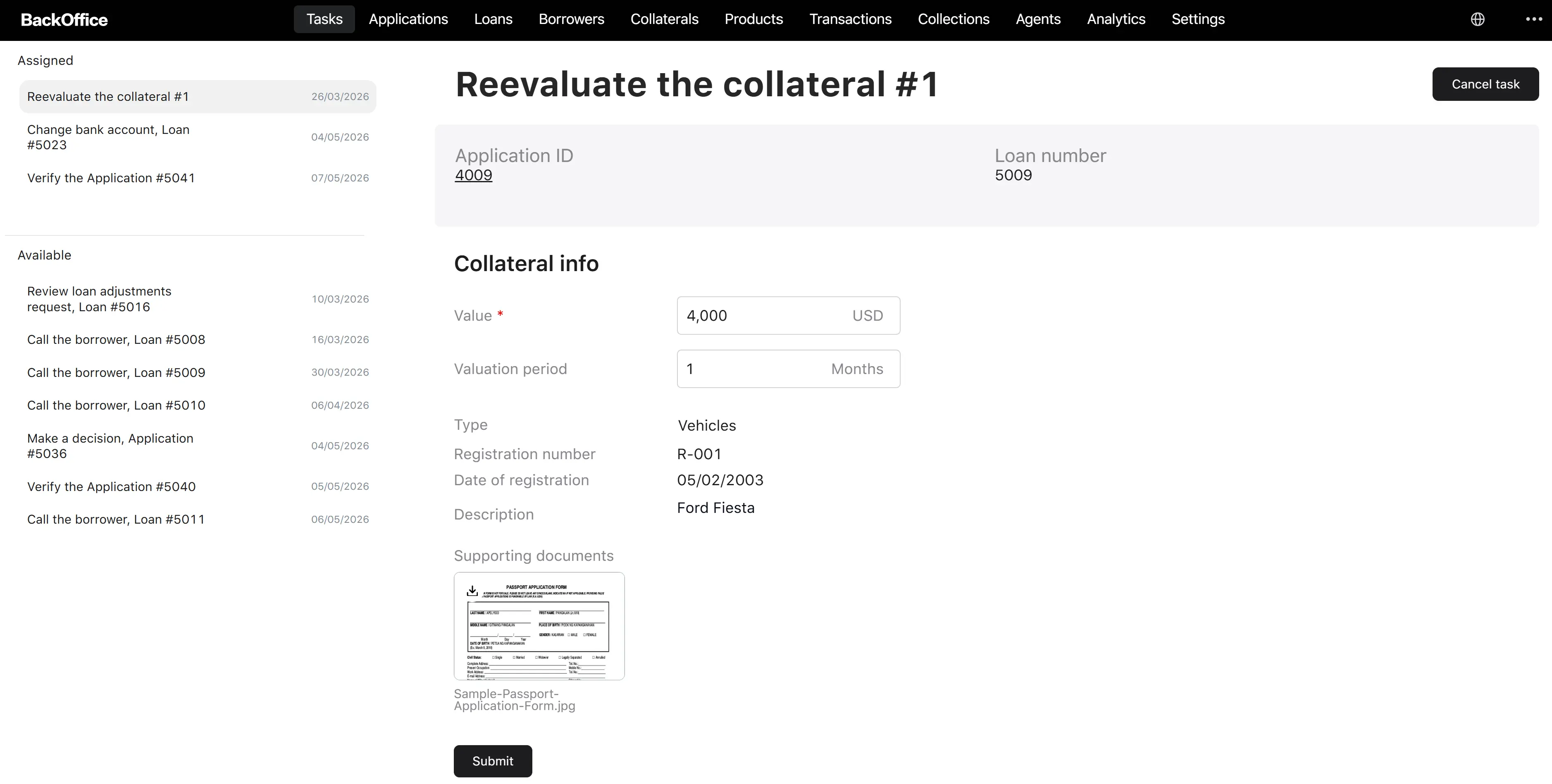
Automatic re-evaluation is mostly hands-off, but it is not fully silent: it produces a user task that a Credit Officer must complete to confirm or update the new valuation. This is the task that ends up on the Credit Officer’s task list at the start of the scheduled day.
Task: “Re-evaluate collateral” (Credit Officer task, started automatically at 3:00 AM on the scheduled date).
The task screen shows:
- A header with links to the related Loan application and Loan (clickable, opens the corresponding card).
-
The Collateral information panel containing two sections:
-
Collateral details with editable fields:
- Value (required, between 0.01 and 100,000,000) — the new collateral value.
- Valuation period (optional, between 1 and 999 months) — how often the next re-evaluation should happen.
- Collateral info — read-only summary of the existing collateral attributes (type, registration number, registration date, description, supporting documents, custom fields, latest and next valuation dates).
-
Collateral details with editable fields:
The Collateral information panel also includes a Submit button (active only when the value is valid).
When the Credit Officer submits:
- The system saves the new value and valuation period.
- The latest valuation date is set to today.
- The next valuation date is recomputed as today + valuation period (if a period is set).
- A re-evaluation event is recorded in the loan history with the new value and the re-evaluation timestamp.
- The loan-level LTV recalculates based on the new value.
The task carries an “unassign on due date” property: if a Credit Officer claims the task and does not complete it by the due date, the task is freed up so another Credit Officer can pick it up.