Overdue loan
Loan moves to Overdue
The platform performs a daily check on every active loan. The check evaluates the loan’s current financial position and assigns the appropriate status. A loan is marked Overdue when:
- it has an outstanding balance still to be repaid, and
- there are unpaid penalties already on the loan, and/or
- there is overdue interest (a scheduled interest payment that wasn’t made), and/or
- there is an overdue principal (a scheduled principal payment that wasn’t made).
Once marked overdue, the platform records the Overdue date — the first day on which the loan was overdue. The number of Days in overdue displayed on screens is calculated from this date forward.
If the borrower later pays enough to clear the overdue interest, overdue principal, and the penalties, the loan returns to Active status, and the overdue date is cleared. If the borrower clears all obligations entirely, the loan moves to Repaid. From any state, the loan can be moved to Written-off by an explicit write-off operation.
The borrower also receives an automated overdue notification on the day the loan first becomes overdue.
Calculation for an overdue loan
While a loan remains overdue, the daily calculation continues to run and applies the loan’s product rules. Several things may be accrued:
| Accrual | What it is | What controls it |
|---|---|---|
| Overdue penalty | A one-time penalty for each missed payment. Accumulates on the loan as Penalties. | The overdue penalty configured on the loan product. |
| Default interest | A separate interest charged on the overdue balance for every day it stays unpaid. Accumulates as Default interest. | The default interest rate configured on the loan product. |
| Regular interest | Ordinary interest accrual continues on the principal balance according to the loan’s interest rate. | The interest rate of the loan (fixed, or floating = prime rate plus margin). |
Product group dependency
The product group is the lending program under which the loan was opened. It groups together loan products that share the same servicing strategy. The product group does not set the penalty or interest rates directly — those are set on each loan product inside the group — but it controls the collection-related parameters that frame the overdue period:
| Parameter on the product group | Meaning |
|---|---|
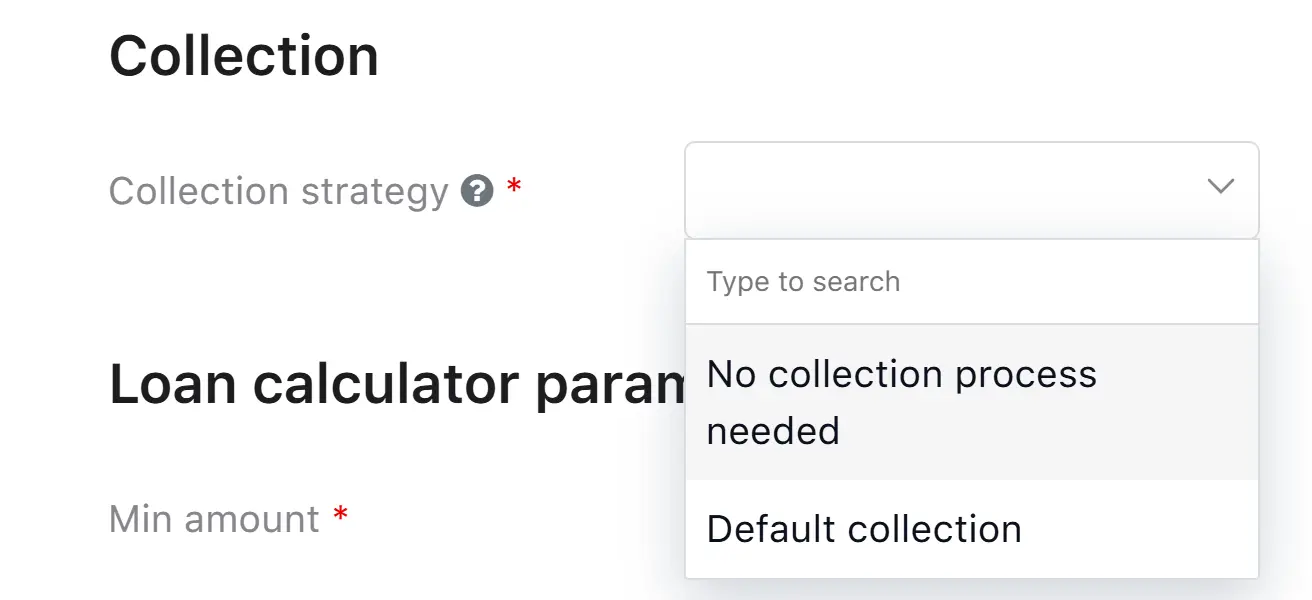
| Collection strategy | Selects which recovery workflow runs when a loan in this group becomes overdue. Supported values: Default (the platform’s standard collection workflow runs) and None (no collection workflow is started — the loan stays overdue with accruals applied, but no contact tasks are created). |
| Days in overdue before collection starts | The waiting period in calendar days between the loan becoming overdue and the first contact task being created. During this delay, the loan is already overdue and continues to accrue penalty and default interest, but no Collection Manager task has been raised yet. |
The loan product inside the group then sets the financial parameters that are actually applied during the overdue period:
| Parameter on the loan product | Meaning |
|---|---|
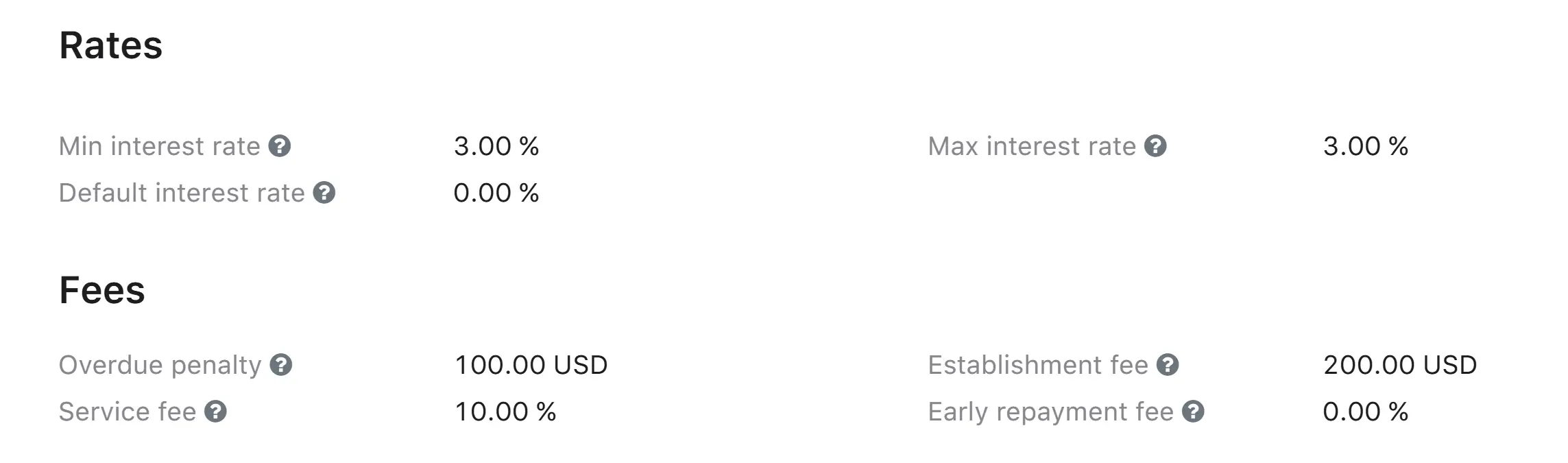
| Overdue penalty | A one-time penalty for each missed payment. |
| Default interest rate | A penalty rate applied daily to the overdue principal balance. |
In short:
- The product group decides whether the collection runs and when it starts.
- The loan product decides how much is accrued (penalties, default interest) while the loan is overdue.